I really
enjoyed reading this excerpt from “Common Sense” and rightfully titled so. After
the introduction, Thomas Paine starts saying this is my argument and all I am
stating are common facts. In the first paragraph of this section, he basically
says “Sit down, shut up, and listen”, which I love. After that, it gets a
little shaky or unclear what he is saying until about a page and a half in.
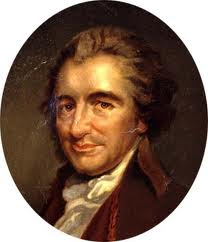
Thomas Paine
starts talking about how some people believe we owe Britain something that they
are our mother/father and we should thank them. Paine replies back in a tone
that kind of says “you stupid idiots, and imbeciles. We owe nothing to Britain.”
I love how he goes into that argument of if Britain
was our parents then America is a fully grown man/woman and don’t
need his/her parents anymore and that Britain should not interfere with America’s
life, but then her reprimands this argument by saying that Britain is not our
parent, because even though they settled here first there are people here from
other countries. “Not one third of the inhabitants, even of this province
(Pennsylvania) are of English decent”(p 329). Then he goes on to say, and you’ll
love this, that if we are subject to England because some of us came from
there, then you can also say that England is subject to France because William
the Conqueror. “The first King of England of the present line (William the
Conqueror) was a Frenchman, and half the peers of England are descendents from
the same country; wherefore, by the same method of reasoning, England ought to
be governed by France”(p 329). Thomas Paine blew my mind away with that,
because most people do not think about England in that respect. Also, he said
that the people that came over to the New World were fugitives and people being
harassed and America is a safe house for them to be free. So all in all, that argument
is copout.
Another argument
he makes is that America should not have any relations with England because it
is a monarchy and they are almost always at war. So when they are at war, we
will have to come save their butts and then we would be in debt or our economy
would decrease etc. It is the same with the whole trade argument.
That is
basically the end of Paine’s argument, but then he goes on to say that if a
person still believes America should be governed by England, then he has
probably not lost a loved one in the war or if he has then he is “unworthy of
the name of husband, father, friend, or lover, and whatever may be your rank or
title in live, you have the heart of a coward, and a spirit of a sycophant (p
331) or according to Dictionary.com, a self-seeking,
servile flatterer, fawning parasite, which makes me laugh a little.
I love the way he entitled this piece; “Common Sense”. It’s
kind of a smack in the face. Paine’s almost saying that he shouldn’t have to
spell this out to you but he is. He’s saying that the people of America should
have the common sense to see that we should not be tied to Britain in anyway
shape or form and that we should keep on fighting for America. “O! ye that love
mankind! Ye that dare appose not only the tyranny but the tyrant, stand forth.
Every spot of the old world is overrun with oppression. Freedom hath been
hunted around the globe. Asia and Africa have long expelled her. Europe regards
her like a stranger, and England hath given her warning to depart. O! receive the
fugitive, and prepare in time an asylum for mankind (p 332).
 I also
love the quote you chose from Henry Thoreau’s Where I Lived, and What I Lived For. It is so poetic and describes
life perfectly. I believe the line is saying that you live life but when you
look at it, you can see the emptiness of life or the shallowness of it. We are
all consumed by the technologies of this world and the societal norm and I do
agree with you that Thoreau wants us to live outside the societal norm, but
like you said, that just isn’t possible because the world is changing everyday
and we must learn to adapt if we want to survive and make a name for ourselves
in this world.
I also
love the quote you chose from Henry Thoreau’s Where I Lived, and What I Lived For. It is so poetic and describes
life perfectly. I believe the line is saying that you live life but when you
look at it, you can see the emptiness of life or the shallowness of it. We are
all consumed by the technologies of this world and the societal norm and I do
agree with you that Thoreau wants us to live outside the societal norm, but
like you said, that just isn’t possible because the world is changing everyday
and we must learn to adapt if we want to survive and make a name for ourselves
in this world.